Burne-Jones painted the knights who tried before – asleep in the thorns. A note on entering the defence innovation market as a software company: a different language, a different rhythm, and a different logic of trust.
In Buscot Park, Oxfordshire, there is a room panelled with four paintings by Edward Burne-Jones: The Legend of the Briar Rose (Buscot Park).
It is Sleeping Beauty, but the painter is not interested in true love’s kiss. The first panel shows a knight entering the briar wood – and finding the knights who came before him, asleep, wound into the thorns (Wikipedia).
I have thought about that panel a lot in the past months. Because that is what the defence innovation market looks like from the outside: a rose in the middle, and a wood full of thorns – with a few well-meaning companies already asleep in it.
Part of my work this year was business development in defence innovation for an international software company in Europe.
Good technology, genuinely dual-use, and a market the company had never sold to. We started with an almost empty contact list.
Here is what I learnt in the briar wood.
First: it is a different language.
Capability gap. CDP and CARD priorities. EUDIS. Research action or development action. Ownership control assessment. Security Aspects Letter. Facility Security Clearance. STANAG. AQAP 2110. DIANA test centres. Dual-Use Regulation 2021/821.
Some of these are acronyms. Some are procedures. Some are signatures you need from a national authority before you can even sit at the table. Together they form a language, and the market listens only to those who speak it.
A software company says: “our product can do this.” The defence world asks: “which capability gap does it close, and is that gap on anyone’s priority list? Is it a research or a development action? Will every partner pass the ownership control assessment? Can the work run under a Security Aspects Letter – and does your facility hold the clearance for it? Is it interoperable, down to the STANAGs?”
The technology does not change. The sentence does. Most of the first days of the job is translation.
Second: it is a different rhythm.
Software we develop in sprints. Defence innovation lives in work programmes, calls and evaluation cycles. The European Defence Fund publishes its priorities year by year; NATO DIANA runs its challenge calls in annual cycles. If you start building your consortium when the call is published, you are already late. The seats at the table are usually taken already.
In practice this means planning backwards from windows that open once a year – and accepting that a good conversation today may become a project in eighteen months.
Third: it is a different logic of trust.
In most markets you can buy attention. In this one you typically cannot. Trust has been building slowly up, mostly through people who already know each other – and it can be lost quickly without knowing.
Building a network from zero meant showing up: at national defence innovation events, at programme info days, in rooms where we were the newcomers. It meant being useful before asking for anything – sharing what we knew about a call, introducing two people who needed each other. Nobody hands you a seat at the consortium table. You earn it by being the partner who makes the proposal stronger.
Fourth: “dual-use” is not a label. It is a decision.
Many companies put “dual-use” on a slide and hope for the best. That is how you get dual-confusion: civilian customers start to wonder, defence buyers are not convinced you are serious.
Dual-use done properly is a set of choices – about the product roadmap, about which partners you work with, about how you talk to each market. It is not a marketing word. It is a strategy, and it needs an owner.
So what does the knight in the painting do differently?
In the old tale he is not braver or stronger than the others. He simply arrives at the right time. When the hundred years are over, the thorns give way.
The defence market works in a similar way – minus the fairy tale. The thorns do not disappear. But they open for those who arrive with the right language, at the right moment of the cycle, with partners who already trust them.
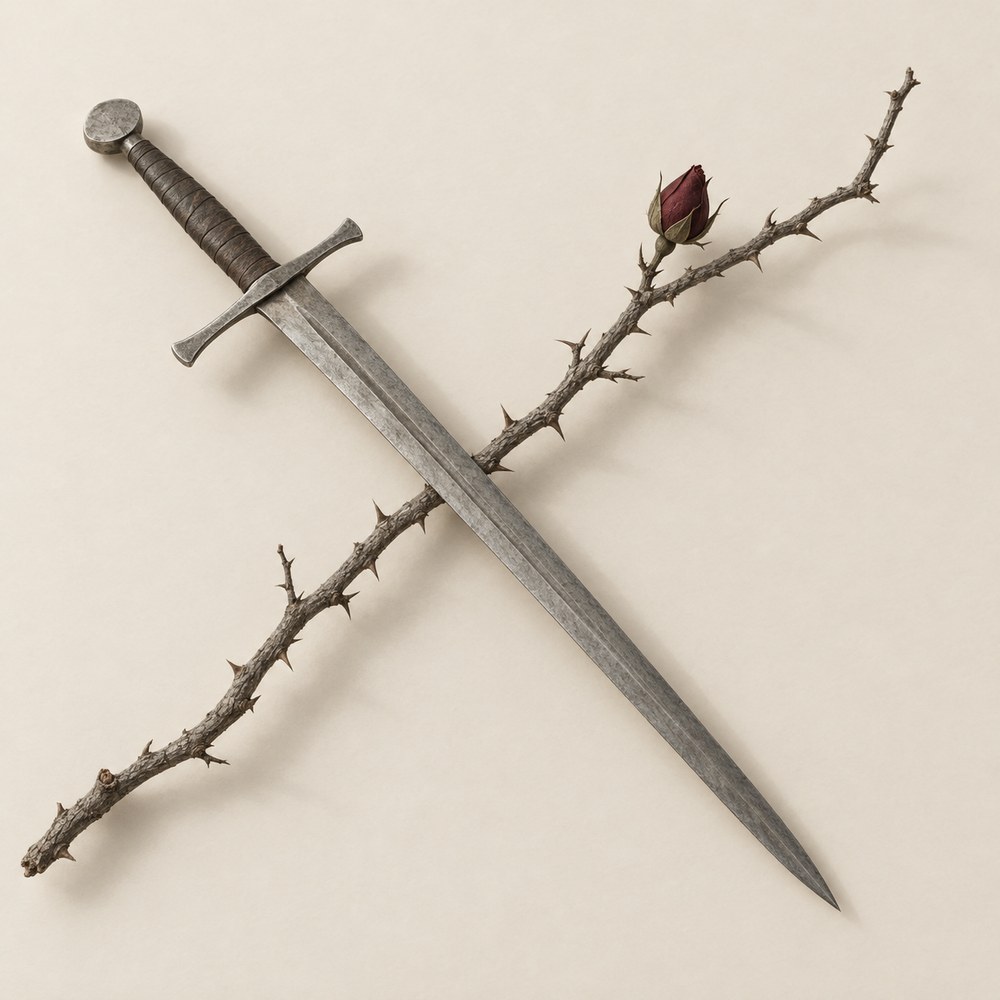
The rose is real. So is the sword. The trick is knowing when to use which.
A question to you:
If your technology could serve defence and security – what is holding you back: the language, the rhythm, or the trust? Or something else?
If you are standing at the edge of the briar wood and wondering where the path is, write to me. I have walked part of it.
Gábor
I help owner-led tech companies turn advanced technology into revenue. If that’s you, write me: priegl.gabor@gmail.com
Leave a Reply