
On the one hand there is a primordial desire of mankind for higher and higher speed, on the other hand there is a wide variety of substitute goods to fulfill that desire. Which technology will win?
A TRAGIC ACCIDENT
It happened on Friday, September 22, 2006, in Lathen, Germany.
Twenty-three people died when a Transrapid maglev (magnetic levitation) train travelling on the system’s test track collided with a maintenance vehicle on the track.

The maglev train was estimated as operating at 170 km/h when the accident occurred. Debris from the accident was spread over a 300 m section of track. The unmanned train, with 31 passengers aboard crashed into a maintenance wagon containing 2 workers.

The 31.8 km test system in Germany had been built by a consortium of Siemens AG and ThyssenKrupp. It was in operation since 1984 and was regularly used by tour groups for demonstration runs. Transrapid trains are capable of speed up to 450 km/h.
This accident was the first on the system that included fatalities; analysts attributed the cause of the accident to a lack of communications between the train operators and the maintenance employees.
TRANSRAPID
The accident in Germany had nothing to do with the Transrapid technology. There is nothing wrong with the technology in itself. It was a pure human fault, including of course the absence of any primitive signalling system applied to prevent collision on the test track.
Transrapid is a proven technology, there is a system in Shanghai that has been working for more than 10 years. So what is the problem? Why don’t operate hundreds of maglevs in the world?
The cost is the problem – as in so many cases -, mainly the capital expenditure required to design and build a stand-alone track system for maglev. The track system includes the 5-6 m high concrete pylons, steel tracks, electromagnets, and the special trains of course.
The huge cost factor also might have triggered Elon Musk’s breaktrough idea of the hyperloop, a disruptive technology and business to be developed and implemented. Or maybe the hyperloop design came from one of Musk’s childhood’s science-fiction stories…
HYPERLOOP
You may sense some traces of irony in my words when I refer to hyperloop.
Yes, I am sceptic about the hyperloop system. This is a healthy scepticism.
Why am I sceptic?
Let’s have a look at the website of one of the most prominent hyperloop developers.
That is Hyperloop One, which is said to be the closest (with informal ties) to Elon Musk.

What does this website speak about? Look at the horizontal menu.
Everything is about a STORY. About a magnificient vision.
About funding this dream. It has a very American taste of course.
I’m not saying that HYPERLOOP ONE won’t work, what I’m saying is that they don’t know if it will work technically and as a business.
Of course I am interested firstly in the technical details. Where to find them on the website? Within the menu item Media(!) you will find a „Fact Sheet And FAQs” item. That is all we can get as of now. If you open it, it will be clear for you that the document contains no fact sheet (of the hyperloop solution in technical terms) at all.
It is a FAQ list and nothing more.
I have the constant feeling that the marketing experts are here far more ahead than the tech guys.
According to Business Insider (07 March 2017) Hyperloop One’s original plan was to present the first full-scale public trial in the first half of 2017. Even this planned date is slightly later than the company’s original timeline.
So, what results has the technology department achieved?
Sorry, that is what we don’t know. What we know of is a demonstration one year ago. (Business Insider, 12 May 2016)
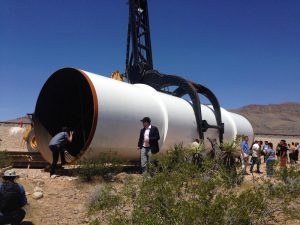
During this demo the electric propulsion system was about to demonstrate its unique capabilities.
In reality the test consisted of sending the company’s linear motor down an open air test track on a sled at more than 100 miles per hour.
That’s it. A sledge watched from several hundred feet away from the track.
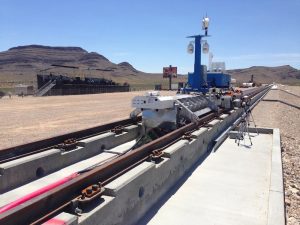
We can say that this was only a very tiny slice of technology to be demonstrated.
And this is only the technology. What about the business?
The cost factor is even far more uncertain than the technology.
If you have 5 minutes to go through the related NASA study (Hyperloop Commercial Feasibility Analysis, July 2016), you will find out why.
Here are some of the main points.
Lack of end-to-end coverage in passenger transport and in cargo shipment.
In passenger transport other modes have terminal stations downtown, while hyperloop won’t have any.
In the cargo shipment segment there are well designed and operated hubs to collect and distribute the shipments, while the hyperloop doesn’t dispose of any.
Almost nothing can be known about the effect of the extreme high speed (760 mph) on humans.
The capacity of hyperloop is far more lower than High Speed Rail.
Cost of land, infrastructure, trains.
Safety issues.
And so on.
HYPERLOOP-MAGLEV-HSR
According to the available sources it seems that neither HYPERLOOP nor MAGLEV can be competitive enough. When it all comes down to money, the High Speed Rail still requires the least investment. Nobody can see now how this situation could be changed in the near future.
I like HYPERLOOP as a concept very much and I root for them to come up with the breakthrough factors in order to make the technology a real winner.
Until then we should stick to HSR.
Leave a Reply