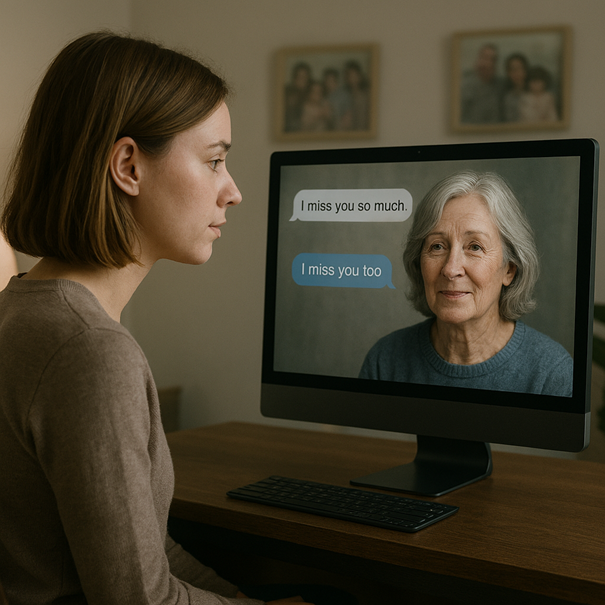
It’s been 22 months since my mother passed. I find myself chillingly contemplating whether to summon her digital ghost… 👻
This is a complex, ethically charged question many grief-stricken people facing these times as AI Griefbots—replicas of deceased loved ones—become a reality.
The question is: What’s still a healthy internal connection and where does an addictive digital echo start? 👇
⚖️ Traditional Therapy vs. Digital Necromancy
The debate isn’t about cutting ties—the big difference lies in the medium and the interaction.
1. One of the Traditional Ways: Continuing Bonds Theory (Non-AI)
This modern therapeutic approach (Stroebe & Schut, Neimeyer) focuses on integration, not detachment.
- The Goal: Teaching the brain that however the loved one is gone, their „presence” and influence can be integrated into the survivor’s internal life and future.
- The Method: Internal work (imagining conversations, reflective journaling, creative expression). The client creates a healed, symbolic version of the deceased.
- The Outcome: Thoughts related to the lost one eventually bring solace or wisdom rather than the pain of absence.
2. The AI Way: The Griefbot (GenAI)
The AI solution offers a never-before external, interactive, and often commercialized experience (Digital Necromancy).
- The Goal: Providing an immersive and interactive platform to engage with a plausible imitation of the deceased. Users have the theoretical and partly pragmatical opportunity to work through “unfinished business”.
- The Method: External interaction with a Large Language Model (LLM) trained on the deceased’s digital data. The bot actively responds giving you the creeps, making the experience feel like an ongoing conversation.
- The Outcome (Observed): Helped some users who felt society was impatient with their grief. It can help clarify the survivor’s version of their history, leading to greater empathy.
⚠️ The Crux: Autonomy and Risk
Here’s where the two paths diverge critically:
| Feature | Traditional Therapy | AI Griefbots (GenAI) |
| Healing Mechanism | Internal transformation and acceptance. | External interaction (role-playing/game). |
| The Risk | Denial, avoidance, prolonged grief. | Addiction/Dependency. Trapping the user in a non-acceptance loop. |
| The Vulnerable | Anyone in grief. | Those with anxious attachment styles (7–10% of the bereaved) and those in the first shock of loss. |
| Trust/Data | Built on trust with a human professional. | Built on the deceased’s digital footprint (often without explicit consent, which is quite understandable). |
🚩 Final Question: The Line in the Sand
Humans always tried to test the latest technology to commemorate loss (photography, radio when those were the breakthrough technologies).
This is however the first tech solution that not only talks back but imitates plastically the presence of the deceased’s personality with personal stories.
Once the bond has been made between you and the replica of your beloved one’s, it won’t be easy not to turn to the ghost if you have questions about your shared past, family issues and secrets.
Now this is definitely not the area where you can expect real and trustworthy answers from the AI, because we all know that AI has a penchant for hallucinating.
It can be really dangerous if you can’t keep a distance.
The Scientific American article (see the link in the Comments) concludes that for some, the bot works, provided they engage with it in an imaginative or fictional mode. The danger lies there when commercial platforms use “engagement tricks” to promote dependency.
Where should leaders and innovators draw the line?
There are some groups of professionals that even suggest that Griefbots should be classified as medical devices and used only under professional supervision.
Let me know your thoughts on this complex ethical dilemma below! 👇
#AIEthics #GriefTech #DigitalLegacy #MentalHealthTech #ContinuingBonds
Read the full thought-provoking Scientific American article and the author’s personal experience here:
Leave a Reply