

THE TOPIC
Findings of research on „Understanding and safeguarding children’s use of AI chatbots”.
Internet Matters, UK, July 2025
Methodology (always a crucial point):
Desk research
Surveys (representative sample of 1,000 UK children aged 9-17 and 2,000 parents of children aged 3-17).
Focus groups (4 x 60-minute, mixed gender, focus groups with 27 children aged 13-17 who regularly use AI chatbots. Children were grouped by age to support safe and open discussion.
THE HIGHLIGHTS
64% user
(64% of children aged 9-17 say they have used an AI chatbot, and almost two-thirds of this segment use them on a weekly basis. The number of children using ChatGPT has almost doubled in 18 months (2023: 23%, 2025: 43%)).
23% seek advice
(23% of children aged 9-17 in the survey who have used AI chatbots said they had used one to seek advice. In focus groups, children described asking AI chatbots for help on a range of topics, from aesthetic choices to working through personal dilemmas and coping with exam stress.
58% believe AI is better than own search
(58% of children who use AI chatbots said they believe using an AI chatbot is better than searching for something themselves.)
51% confident that AI advice is true
(Over half (51%) of children who have used AI chatbots said they were confident that the advice they get from an AI chatbot is true.)
16% cf. 4% „wanted a friend” (vulnerable cf. non-vulnerable children)
(The question was: why they had spoken to an AI chatbot, vulnerable children were four times more likely than their non-vulnerable peers to use one because they “wanted a friend”.
50% cf. 31% „it is like talking to a friend” (vulnerable cf. non-vulnerable children)
26% cf.12% „rather talk to a chatbot than a real person” (vulnerable cf. non-vulnerable children)
23% has no one else to talk to (of vulnerable children) (Nearly a quarter of vulnerable children (23%) said they use AI chatbots because they don’t have anyone else to talk to. These findings suggest that, for some children, AI chatbots are filling emotional or social gaps that may not be met offline – offering not just information or entertainment but a sense of connection.
THE HITCH
Despite their growing use among younger children, many AI chatbots currently lack robust age checks.
ChatGPT, Snapchat’s My AI and character.ai did not have any robust age verification mechanisms in place when the testing was conducted. While some asked for a date of birth or required an email sign-up, none attempted to verify the age provided beyond self-declaration at sign-up.
As a result, children under 13 de facto can access AI chatbots regardless of the minimum age specified in their Terms of Service.
This survey shows too that 58% of children aged 9-12 reported using AI chatbots, even though most platforms state their minimum age requirement is 13. The lack of effective age checks raises serious questions about how well children are being protected from potentially inappropriate or unsafe interactions.
SO WHAT NOW?
Children’s use of AI chatbots for companionship is already a reality.
As these tools become more sophisticated and emotionally responsive, their impact on children’s wellbeing demands urgent attention. Long-term research is needed to understand how emotionally intelligent AI affects children’s development, positively or negatively.
What do the parents do?
They worry, that’s all natural:
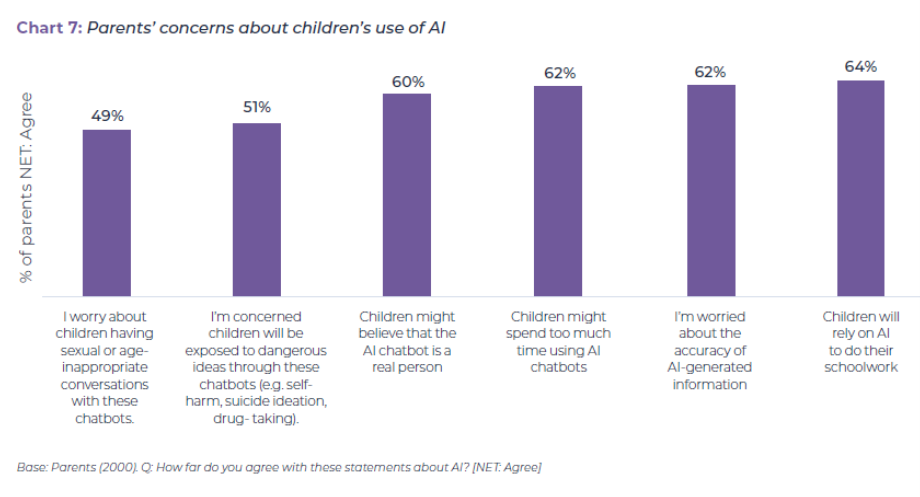
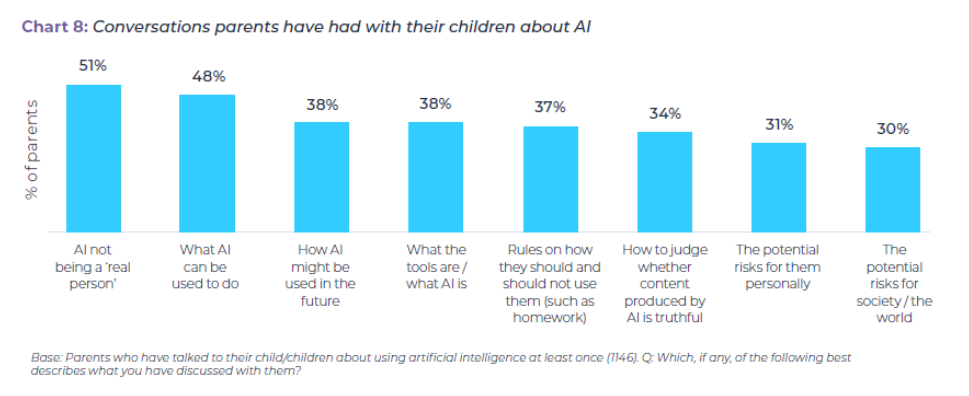
Fortunately they also have talks with their children.
79% of children report that their parents are aware of their AI chatbot use, and 78% of all children said their parents had spoken to them about their use of AI.
In my opinion that’s reassuring and promising, if there is parents – children communication it can always be improved and it builds a common platform for parents and children.
There is no other remedy.
Reference:
„Me, myself & AI: Understanding and safeguarding children’s use of AI chatbots”
internet matters.org, UK
Leave a Reply