
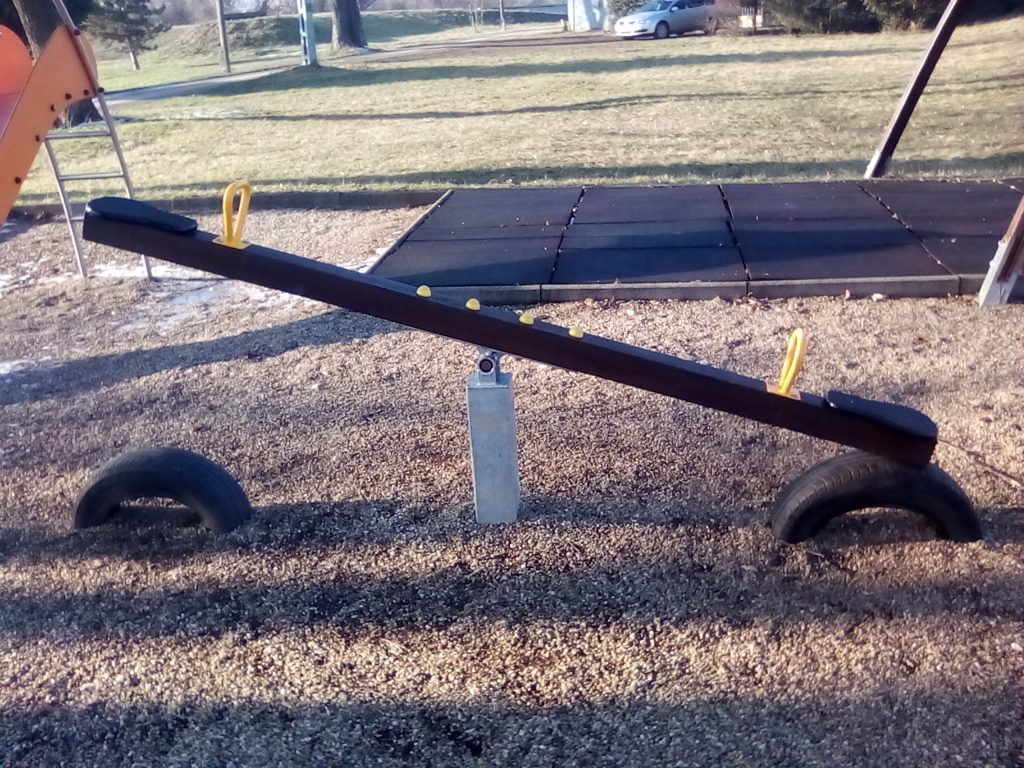
Anyone involved in custom software development experiences that, due to the project-oriented nature of the activity, there is rarely a state of equilibrium in terms of the company’s performance: there is either too much work or too little compared to the size of the team.
It’s like the seesaw from our childhood playground. As long as children of similar weight were swinging, everything worked fine, but if there was a change at one end and a heavier child sat down, the child at the other end had to hold on tight to balance the seesaw or even stay on the swing and not fall offat all. And you remember, don’t you, when a daring boy jumped onto the middle of the seesaw, one foot on one arm of the seesaw, the other on the other, and helped maintain balance and rhythm (or quite the opposite, depending on his intention:))?
If we have the image of the playground seesaw in front of us, let’s see what all is in this metaphor!
Let’s take a simple, ultra-flat software development company. It starts with around ten people, aiming to ensure healthy, sustainable growth year after year, in revenue and EBITDA.
Our seesaw has an order backlog roughly sized for the team, consisting of a few projects on which the developers are diligently working.
Because they work excellently, their good reputation spreads, and the company receives new orders. The expected workload increases, so the CEO in the middle of the seesaw helps restore balance by hiring more developers for the company.
But only cautiously, because increasing the team size will temporarily reduce the developers’ workload, negatively impacting EBITDA: the seesaw is a delicate instrument, and it must be handled carefully!
Then, of course, once the team expansion is done, the seesaw tips, and the CEO focuses on increasing the order backlog.
And if the team is skillful, they play with the seesaw continuously and beautifully, with relatively small amplitudes, and the company grows.
This is a sensitive system, and moreover, as the company grows – let’s imagine it this way – the arms of the seesaw become longer (to accommodate the employees on one side and the projects on the other), the model’s sensitivity to one unit of intervention increases, the swings can become larger, meaning the business risk increases.
After years of continuous corporate growth, due to the elevated risk level, a clumsy intervention on any arm of the seesaw can have serious negative consequences.
However, without rough external interventions, with careful management within the equilibrium range, the team achieves significant (financial) results and professional successes.
Closing Thought
The seesaw metaphor above is a system; every element is important: the development team as a whole and individually every member of the team, the flat organization, regular, honest, to-the-point communication, the CEO.
If anyone is still curious about the “essence” of the above, “what makes” the whole thing, they should read István Örkény’s writing: The Meaning of Life and meditate longer on the topic.
Leave a Reply